


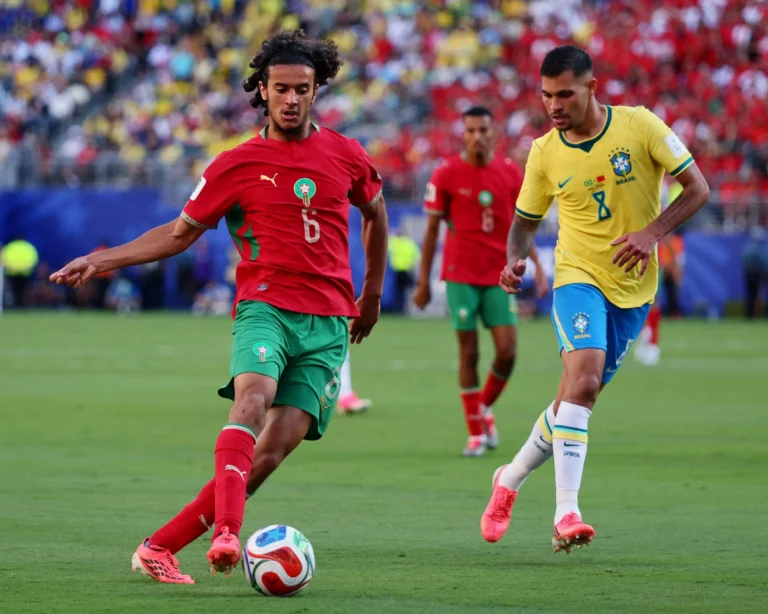
Three decades after their inaugural match, Morocco and the Netherlands are set to clash in a highly anticipated last-32 contest. Their first official encounter occurred during the 1994 World Cup in Orlando, where the Netherlands emerged victorious with a score of 2-1. However, much has evolved since then, and Morocco’s rich footballing history remains a central theme.
The setting for Monday’s showdown is Monterrey, a city where Morocco’s Atlas Lions made history during the 1986 World Cup by being the first African team to advance beyond the group stage. Many Moroccan supporters see this as a prime opportunity for revenge and a chance for glory. Their confidence is bolstered by their impressive semi-final run in Qatar four years ago, where they defeated footballing giants like Belgium, Spain, and Portugal. Now, they have their sights set on another formidable European opponent.
“It’s a shame two such great footballing nations meet this early in the knockout stage,” says Hassan Bahara, a Moroccan-Dutch author and journalist. “I’d have hoped they’d face each other later, after both had the chance to show the world what they’re capable of”
This match stands out as the only last-32 pairing featuring two teams that finished their group stage with seven points each and are both ranked within the top ten of FIFA’s standings. This will also be Morocco’s second encounter with a strong contender for the title, following their Group C opener against Brazil, which ended in a 1-1 draw. The matchup against the Netherlands is further enriched by its social and cultural significance.
In the 1960s, many Moroccans migrated to the Netherlands in search of better opportunities, and generations later, their descendants are proudly representing Morocco on the world stage. “The street football that Dutch and Moroccan kids once played against each other in Amsterdam’s neighbourhoods has, in a sense, arrived on the world stage,” Bahara explains. “That backstory gives this game a layer of meaning that simply would not exist against any other opponent.”
Three players embody this narrative: Noussair Mazraoui, Sofyan Amrabat, and Anass Salah-Eddine, all of whom were born and raised in the Netherlands. Their journeys to representing the Atlas Lions came at various stages, with Amrabat making his debut at the Under-17 World Cup in 2013, Mazraoui at the under-20 level, and Salah-Eddine joining shortly before the last Africa Cup of Nations.
“The feeling is almost that of a derby,” says Jean-Paul Rison, a sports journalist based in Utrecht. “Ninety-nine percent of the people over here will be in total harmony. The only aspect I’m not looking forward to is how some people will fit this game into their agenda of hate.”
Bahara is acutely aware of the potential tensions that this match could provoke. “My concern is that certain right-wing media like De Telegraaf and far-right politicians like Geert Wilders will try to inflame tensions,” he states. “Wilders has wasted no time: he immediately started posting AI-generated images on social media designed to provoke the Moroccan community.” There is hope that the excitement of the match will overshadow these issues, allowing the players and fans to share in a memorable World Cup experience.
Morocco has consistently performed well in recent years, having won this year’s Africa Cup of Nations amid some controversy. Their strong scouting efforts and effective local training programs have produced talented players like Ayyoub Bouaddi, the 18-year-old midfielder who impressed against Brazil and has continued to shine at this World Cup. With a fearless approach, Morocco enters this intriguing match against the Netherlands with confidence in their capabilities as they aim for the ultimate prize this summer.
- World Cup 2026
- Morocco football team
- World Cup
- features